
Analytical Spectrophotometry & Fused Silica Reference Standard · Qvarz LLC (US EIN 33-2750234)
Quartz Cuvette Optical Pathlength Accuracy (0.1 mm–100 mm), Z-Dimension Beam Alignment (8.5 mm vs. 15 mm) & Beer-Lambert Linearity Guide
Analytical Scope & Metrology Abstract
Quantitative UV-Vis spectrophotometry—spanning pharmacopeial USP <857> dissolution verification, nucleic acid A260 mass concentration, and sub-ppb colorimetric trace water assays—depends directly on Beer-Lambert pathlength accuracy and unclipped beam geometry. Two geometric mismatches inside the sample compartment routinely introduce 10% to 90% systematic bias: (1) pairing a black-masked sub-micro cuvette aperture with an incompatible spectrophotometer Z-height (8.5 mm vs. 15.0 mm optical axis elevation above the holder datum), clipping the probe beam and inducing stray-light plateaus; and (2) measuring dilute or concentrated solutions outside the 0.15–1.20 AU photometric minimum-uncertainty window instead of scaling pathlength b from 1 mm to 90 mm.
Key Metrology Parameters & Beam Geometry
Optical Path Span0.10 mm to 100.0 mm (±0.01–0.02 mm)
Z-Axis Standards8.5 mm vs. 15.0 mm (20 mm specialty)
Optimal Photometric Band0.15 – 1.20 AU (Min dC/C @ 0.43–0.87 AU)
Substrate CalibrationJGS1 Synthetic Silica · T ≥ 80% @ 200 nm
| Cell Architecture & Pathlength (b) | Nominal Chamber Volume | Z-Dimension Datum Rule | Target Analyte Regime | Calibrated Qvarz Reference |
|---|---|---|---|---|
| Sub-Micro Self-Masking (10 mm) | 50 µL – 100 µL | Mandatory Z = 8.5 mm or Z = 15.0 mm match | Purified DNA/RNA, scarce enzymes, proteins | VNE069 (50 µL) · VNE071 (100 µL, Z=15 mm) |
| Semi-Micro / Slit Cell (10 mm) | 350 µL – 1,400 µL | Vertical slot spans both 8.5 & 15.0 mm | Biochemical kinetics, Bradford & BCA assays | Frosted / black-wall 10 mm micro series |
| Standard Macro Reference (10 mm) | 3.5 mL (12.5 × 12.5 × 45 mm) | Unobstructed 10 × 35 mm clear aperture | Routine UV-Vis baseline & holmium calibration | VMV34 (3.5 mL, 190–2,500 nm) |
| Extended Rectangular Cell (20–60 mm) | 7.0 mL – 21.0 mL | Requires long-path rectangular carriage | Low-turbidity potable water, trace phosphate | VNE067 (60 mm path, 21 mL thermally fused) |
| Ultra-Long Trace Cell (80–100 mm) | 28.0 mL – 35.0 mL | Collimated axis; ±0.5 °C thermal blanking | Sub-ppb environmental colorimetry & UPW QC | VNE087 (80 mm) · VNE090 (90 mm, 31.5 mL) |
Section I — Z-Dimension Optical Axis Calibration (8.5 mm vs. 15.0 mm) in Sub-Micro Apertures
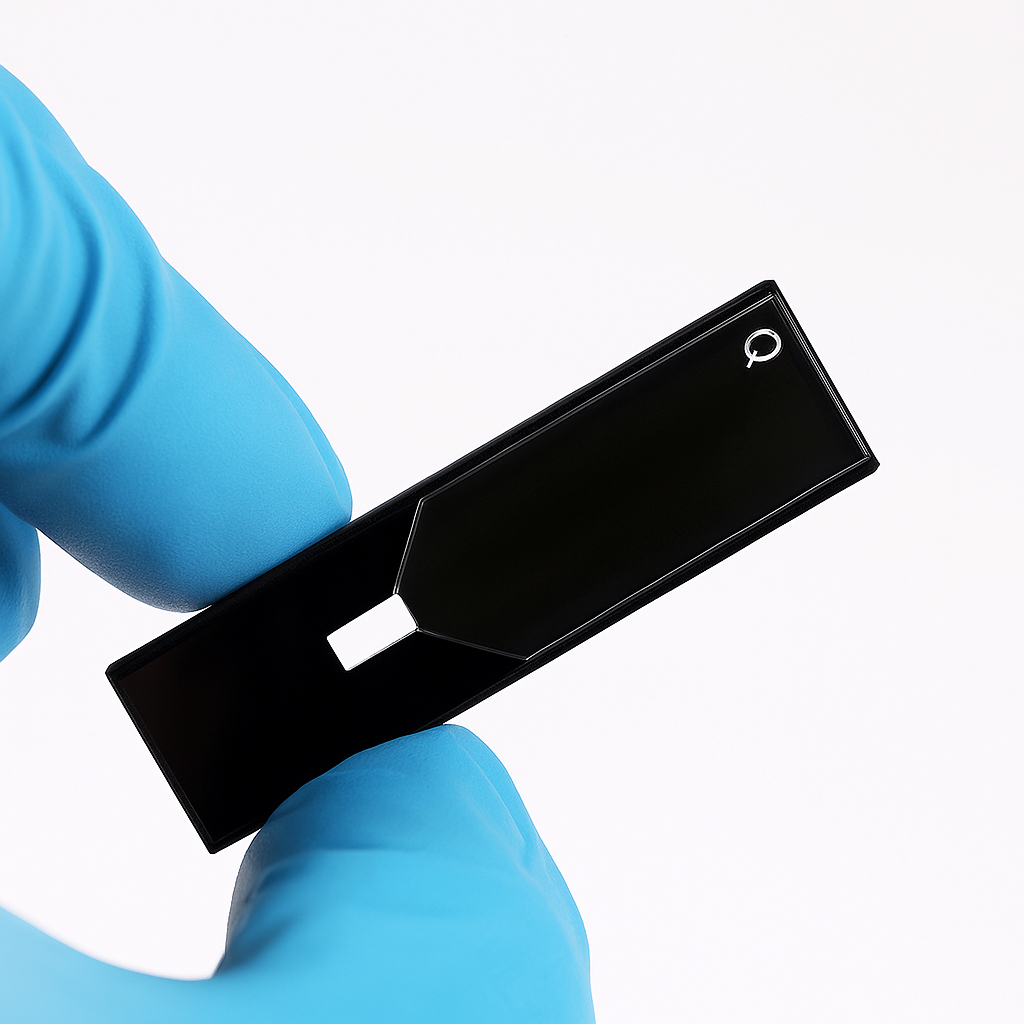
Standard 3.5 mL macro spectrophotometric cells expose an unobstructed 10 mm × 35 mm polished quartz aperture that transmits commercial instrument beams regardless of vertical beam height. When sample volume scales down to 50 µL or 100 µL (such as Qvarz VNE069 and VNE071 sub-micro cells), the internal fluid cavity contracts to a precision 1–2 mm channel elevated atop a solid opaque black-quartz pedestal so a microliter droplet sits squarely across the probe beam while peripheral un-interacted rays are absorbed.
Commercial benchtop spectrophotometers divide into two non-interchangeable Z-dimension standards—defined as the vertical elevation in millimeters from the bottom floor of the 12.5 × 12.5 mm cell carriage to the centroid of the monochromatic beam: Z = 8.5 mm (standard on Agilent Cary, Beckman, Shimadzu, Jasco, and PerkinElmer benches) versus Z = 15.0 mm (standard on Thermo Scientific Evolution/Genesys, Eppendorf, Biochrom, and Hitachi instruments, with Z = 20 mm on select accessories). Seating a Z = 15.0 mm sub-micro cuvette inside an 8.5 mm carriage blocks over 95% of incident flux against the solid pedestal, producing apparent absorbance spikes above 2.5 AU on pure water. Always verify instrument Z-height—or perform a 530 nm white-cardstock pinhole check inside the sample holder—prior to specifying sub-micro part numbers.
Section II — Pathlength Scaling (10 mm to 90 mm) Across the Photometric Precision Window
Double-beam photomultiplier and photodiode-array spectrophotometers encounter dark-current and baseline-drift noise floors when absorbance falls below 0.020 AU (T = 95.5%), while polychromatic stray light (~0.02%–0.08%) flattens calibration slopes above 2.0–2.5 AU. Rather than concentrating trace aqueous standards via rotary evaporation—which risks volatile loss and vessel contamination—metrological best practice scales optical pathlength b proportionally.
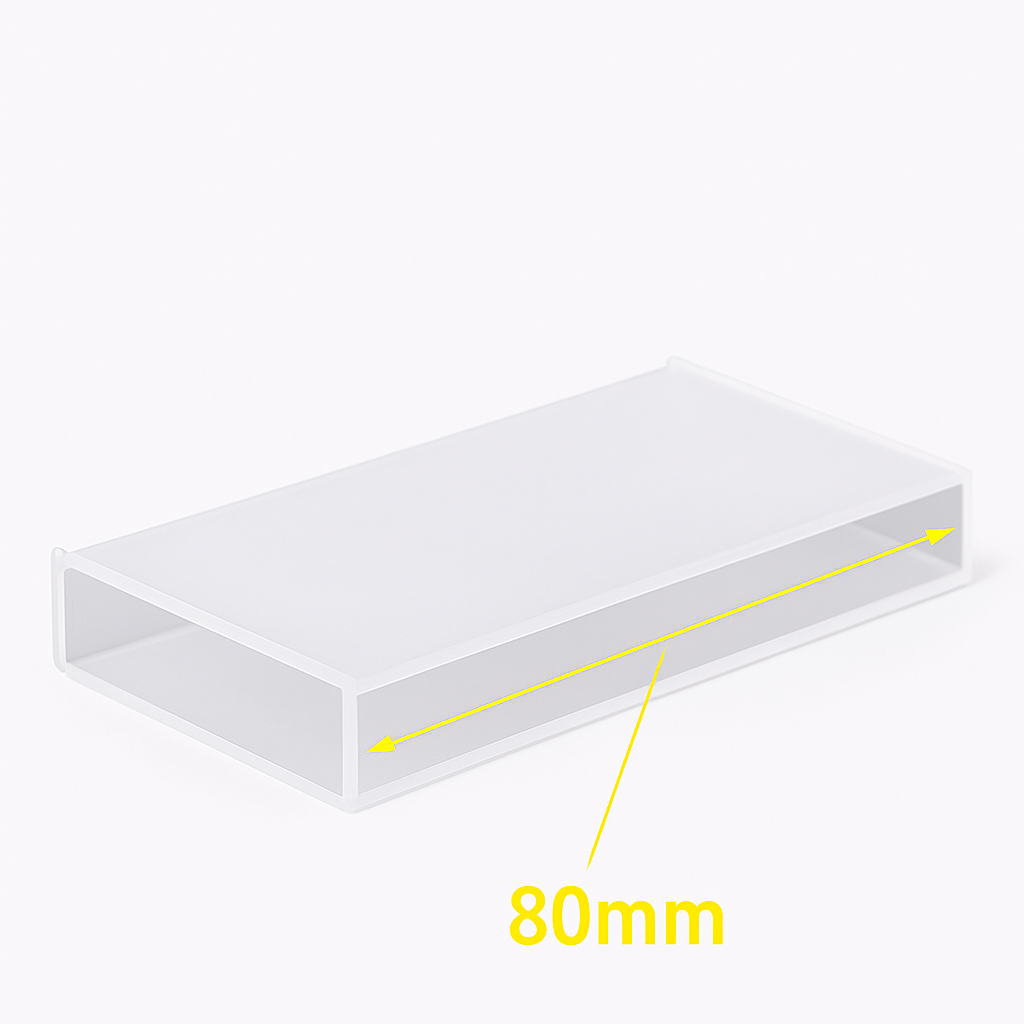
Transitioning from a 10.0 mm cell (VMV34) to a 60.0 mm thermally fused cell (VNE067), 80.0 mm cell (VNE087), or 90.0 mm rectangular absorption cell (VNE090) amplifies optical absorbance by 6× to 9× linearly, elevating a noisy 0.008 AU trace reading into a repeatable 0.072 AU peak. Because 60–90 mm cells contain 21.0 mL to 31.5 mL of solution along an extended optical path, equilibrate blank and sample aliquots within ±0.5 °C to prevent refractive-index Schlieren beam steering across the detector element.
Section III — Dimensional Pathlength Uncertainty, Window Wedge Parallelism & Pair Matching
Calibrated Qvarz UV-quartz absorption cells (190–2,500 nm) control internal optical pathlength within ±0.01 mm to ±0.02 mm on 10 mm geometries (≤ 0.1%–0.2% fractional pathlength contribution) while holding window wedge parallelism within arcminutes so transmitted rays strike the detector normal without lateral displacement.
For dual-channel reference/sample spectrophotometers, audit empty dry cell pair matching at 200 nm, 220 nm, and 260 nm (verifying ΔT ≤ 0.5%–1.0% between paired cells), polish exterior clear windows with lint-free optical tissue moistened in spectroscopic alcohol prior to measurement, and orient the etched Qvarz datum panel toward the incident source on every scan to cancel residual microradian wedge.
Section IV — Spectrophotometric Receiving Inspection & Calibration Protocol
Each incoming optical cell lot should undergo baseline verification inside a temperature-equilibrated spectroscopy room (20–25 °C) using traceable holmium-oxide wavelength filters and potassium-dichromate absorbance standards prior to quantitative analytical sample campaigns:
- Confirm instrument optical beam-center elevation (Z = 8.5 mm vs. Z = 15.0 mm from cell-holder base) prior to requisitioning black-masked sub-micro (< 700 µL) cuvettes.
- Match clear polished window count to optical topology: 2 opposite windows for collinear 180° absorbance versus 4 or 5 clear polished faces for orthogonal 90° fluorometry and DLS.
- Specify monolithic thermally fused or optically contacted quartz (zero organic cement) for concentrated mineral acids, halogenated solvents, and elevated-temperature kinetics.
- Record empty dry reference transmittance at 200 nm against air (acceptance: T ≥ 80%, A ≤ 0.097 AU) and maintain identical front-window orientation for ±0.002 AU repeatability.
Section V — Calibrated Qvarz Reference Part Numbers & Selection Schedule
Stocked optical cuvettes and specialty flow cells ship worldwide in protective metrology foam cases. Institutional buyers may check out online immediately (code VIP10 applies a 10% repeat-lab discount on qualifying stock orders ≥ $150 USD) or submit formal Purchase Orders via sales@qvarz.com:
| Visual | Reference SKU | Optical Description & Certified Geometry | Unit Price | Procurement |
|---|---|---|---|---|
 |
VNE090Calibrated Stock |
(VNE090) 31.5mL Long Pathlength Absorption Quartz Cuvette, Bonded, Lightpath 90mm, Quartz 90.0 mm Path · 31.5 mL · 2 Clear UV Windows (190–2500 nm) |
$92.00 USD | Spec & Order → |
 |
VNE087Calibrated Stock |
(VNE087) 28mL Long Pathlength Absorption Quartz Cuvette, Bonded, Lightpath 80mm, Quartz 80.0 mm Path · 28.0 mL · 2 Clear UV Windows (190–2500 nm) |
$82.00 USD | Spec & Order → |
 |
VNE071Calibrated Stock |
(VNE071) 100uL Sub Micro Absorption Cuvette, Black, Bonded, 2 Windows, Z dim 15mm 10.0 mm Path · 100 µL · Black Self-Masking · Z = 15.0 mm |
$83.00 USD | Spec & Order → |
 |
VNE069Calibrated Stock |
(VNE069) 50uL Sub Micro Absorption Cuvette, Black, Bonded, 2 Windows, Z dim 8.5/15mm 10.0 mm Path · 50 µL · Black Self-Masking · Specify Z = 8.5 / 15 mm |
$76.00 USD | Spec & Order → |
Section VI — Metrology & Institutional Procurement Clarifications
M.1 How do I verify spectrophotometer Z-dimension when the OEM manual is unavailable?
Tune the monochromator to 530 nm visible green, place a 12.5 mm wide millimeter-graduated white paper strip vertically onto the bottom floor of the cuvette holder, and measure from the base datum to the center of the green beam spot—it will sit at either 8.5 mm or 15.0 mm.
M.2 Why must sub-micro cuvettes (VNE069, VNE071) incorporate opaque black-quartz masking walls?
Around a narrow 1–2 mm sample slit, clear or white-frosted sidewalls pipe unabsorbed peripheral beam rays directly to the photodiode (sidewall waveguide bypass), causing severe negative Beer-Lambert curvature above 0.5 AU. Opaque black quartz blocks 100% of out-of-channel light.
M.3 Do 60 mm, 80 mm, and 90 mm rectangular cuvettes fit inside a standard 12.5 × 12.5 mm square turret?
No. Long-path rectangular cells maintain the standard 12.5 mm width and 45 mm height but measure 62.5 mm to 92.5 mm along the optical axis, requiring a rectangular long-path accessory carriage in your spectrophotometer compartment.
M.4 Does Qvarz LLC issue signed US IRS Form W-9 documentation for university metrology and QC cores?
Yes. Qvarz LLC (Sheridan, WY 82801, USA · Federal EIN 33-2750234) provides signed IRS Form W-9, domestic U.S. ACH/Fedwire settlement, and formal Pro Forma / Net-30 PO quotations via sales@qvarz.com and /contact/.